

SOURCE-LED ANALYSIS
Out Run: how a fork in the road creates more than a race
Reading route, time and music together to examine the feeling of freedom in SEGA’s 1986 driving game.
Catalog data — identifies the version
- Catalog year
- 1986
- Manufacturer
- Sega
- Genre
- Driving / Race (chase view)
- Metadata players
- 1
- Set ID
- outrun
- Cached status
- GOOD
These fields come from the existing metadata cache dated 30 July 2026. Player count does not promise simultaneous online play, and emulation status is not a test result from this device.
Compare in the catalog →Which Out Run?
SEGA dates the original arcade OutRun to September 1986. Its branching roads, multiple endings and selectable music are the historical anchors here. Driving systems from later OutRun releases should not be attributed to this version. The catalog ID outrun denotes a particular arcade set; a shared series name does not establish identical rules across adaptations.
A chosen road rather than a progress line
A fork matters for more than providing a second route. It connects the driving already performed to an anticipated landscape. Choice creates a kind of ownership independent of speed: I chose where this journey went. My interpretation is that this modest directional decision can broaden replay beyond pursuing a better score. Curiosity about another road offers another reason to return.
Music selection sets the tone
SEGA documents three selectable tracks. This choice frames the drive before play begins; it is not equivalent to a volume setting. Music becomes a chosen companion rather than only feedback announcing success. That does not establish a universal psychological effect such as “every player relaxes.” The narrower design claim is that the entry interface adds a personal decision to the beginning of the experience.
How can time pressure coexist with freedom?
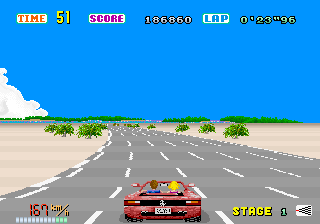
A touring image and time pressure need not cancel each other out. Scenery promises somewhere to go, while the timer prevents an unlimited sightseeing ride. The screen offers two readings: the place you want to reach and the pace needed to reach it. This dual layer is useful to interface design too. An attractive destination is insufficient when available time and current process state are not understandable.
From physical steering to digital input
Preserving the picture in a browser does not preserve steering-wheel or pedal feel. Translating analogue motion into digital direction keys can change how corrections are made. An adaptation should therefore be examined for short and long input responses as well as visual clarity. This article measures no device’s input delay. It offers an assessment checklist, not a benchmark result.
Decision map
| Element | Function | Interpretation |
|---|---|---|
| Route fork | Journey direction | Curiosity and replay |
| Music | Experience tone | Personal entry choice |
| Driving input | Immediate correction | Analogue/digital difference |
Limits of the credit information
This dossier concerns SEGA’s arcade release. An individual team list has not been reverified here.
Sources and scope
- SEGA — OutRun arcade tarih kaydı (1986/09)
Date, branching routes, five endings, three music choices and two-speed gears.
- Arcade Database — outrun
Metadata provenance link; cached fields were not freshly recrawled from that site in this revision.
Read alongside
This is neither a distribution license nor a play-test report. Public game access requires separate verification of the applicable rights.