

SOURCE-LED ANALYSIS
After Burner II: why speed and control are not the same feeling
Throttle, target tracking and divided attention in After Burner II: two illustrated decision examples grounded in SEGA’s records.
Updated ·
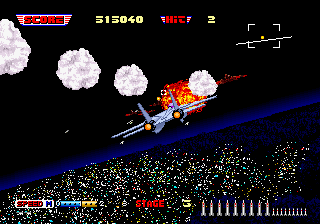
Catalog data — identifies the version
- Catalog year
- 1987
- Manufacturer
- Sega
- Genre
- Shooter / Flying (chase view)
- Metadata players
- 1
- Set ID
- aburner2
- Cached status
- GOOD
These fields come from the existing metadata cache dated 30 July 2026. Player count does not promise simultaneous online play, and emulation status is not a test result from this device.
Compare in the catalog →Version: the II matters
SEGA’s arcade history dates After Burner II to October 1987. A throttle and five added stages make II more than a name change. The record identifies 23 stages, the X Board and a moving double-cradle cabinet. These details should not be transferred automatically to console adaptations or After Burner Climax. This dossier concerns arcade II; a home-version manual is not treated as evidence for the arcade hardware.
Finding a target versus reading danger
Two visual tasks reveal the design tension: finding a target to lock onto and following movement that threatens your own aircraft. Concentrating on the reticle can make peripheral signals harder to notice. Spectacle is therefore also an attention-sharing problem. I read the game as a staging of attention under time pressure rather than a lesson in flight physics. This is interpretation, not a frame-by-frame measurement of enemy behaviour.
Why the throttle is more than a speed switch
Making speed a separate control adds a decision beyond aim and position. SEGA describes the throttle as changing scrolling speed. The design consequence is that a scene can be read at a different rhythm: more control does not necessarily mean an easier decision. Digital browser input may retain access to the function, but it does not automatically retain the continuous physical position of a lever or the movement of the cabinet.
A compact map of three decisions
The table describes attention costs, not a binding command list. We do not prescribe fixed keyboard keys: emulator core, input mapping and device may differ. When examining a licensed copy, checking its input settings is safer than assuming that an on-screen A/B label uniquely identifies a function.
The same scene, a different reading rhythm
SEGA says the II throttle changes scrolling speed; lock-on missiles are limited and can be replenished during the game.
In the first diagram I keep the aircraft and target in the same positions and change only the throttle choice. Shorter and longer motion lines represent different rhythms. My question is not which speed is stronger, but in what order I should read the target, warning and way out. Changing throttle does not remove a threat; it adds a timing choice to aiming and positioning. The lines are not measured speed ratios, reaction times or distances from a stage. SEGA’s record of the first After Burner explicitly lacking a throttle also makes the II distinction useful.
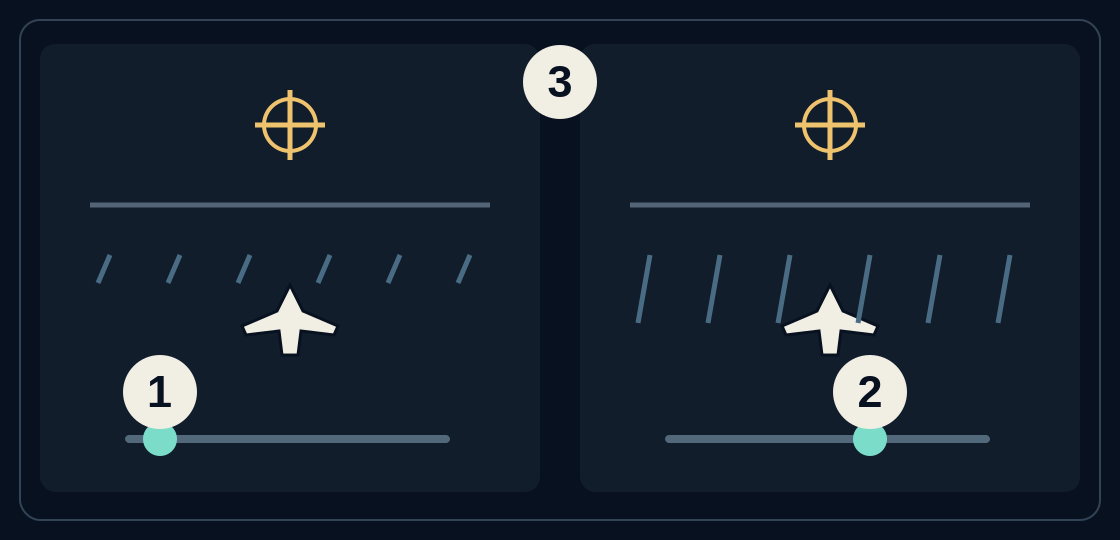
- 1Lower throttle choice
- 2Higher throttle choice
- 3Same scene positions; lines are not measurements
The question outside the reticle
The second diagram places a target above, an approaching threat on the right and open movement space on the left. Tracking the target and looking for a way out are different attention tasks. Watching only the reticle can delay reading positional information; watching only the open space can postpone target selection. My interpretation is that a sense of control does not grow simply by concentrating every task in one spot. This constructed situation is not a recorded attack sequence or a guaranteed dodge route. It makes two questions within one scene visible.
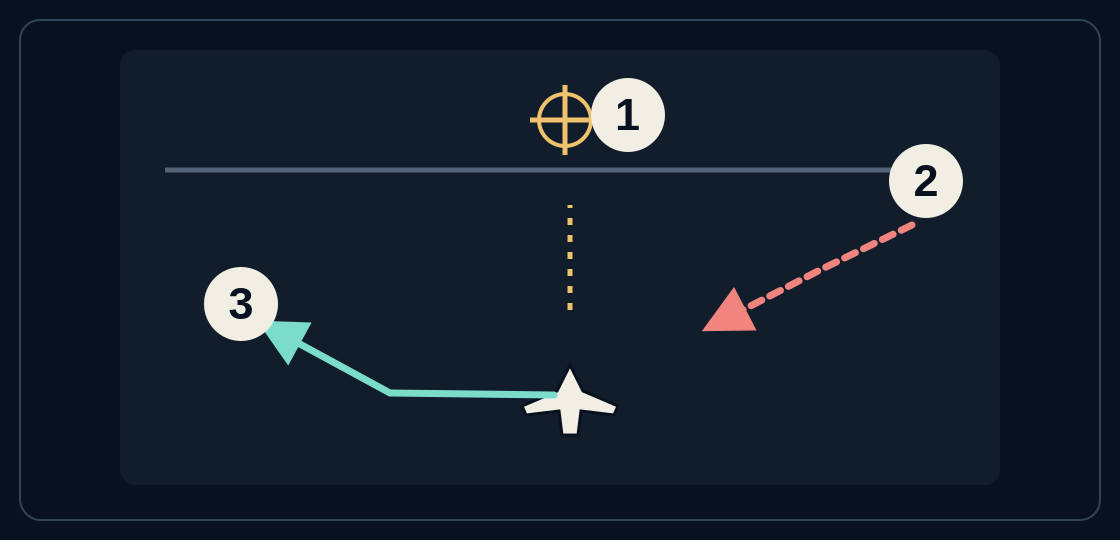
- 1Potential lock-on target
- 2Illustrative approaching threat
- 3Illustrative open movement space
Questions for evaluating a browser adaptation
Is the throttle function actually reachable? Is the reticle legible on a small screen? Do controls cover warnings? These differ from a simple “it launched” check. Successful loading does not establish equivalence with the original cabinet. No device-specific latency measurement, moving-cabinet comparison or completed play session was performed for this dossier. Stating that limit lets the reader separate historical evidence from adaptation assessment.
Decision map
| Element | Function | Interpretation |
|---|---|---|
| Lock-on | Select a target | Central attention |
| Evasion | Track danger | Peripheral reading |
| Throttle | Change rhythm | Lever versus digital input |
Limits of the credit information
A SEGA production. Individual team credits are not listed because they have not been reverified for this dossier.
Sources and scope
- SEGA — After Burner II arcade tarih kaydı (1987/10)
Date, X Board, throttle, 23 stages, lock-on missiles and moving cabinet.
- Arcade Database — aburner2
Metadata provenance link; cached fields were not freshly recrawled from that site in this revision.
Verified claims and sources
- SEGA · After Burner II
- Claim
- Throttle, limited replenishable lock-on missiles and 23 stages.
- Evidence
- Arcade history entry; 1987/10 description
- SEGA · After Burner
- Claim
- No throttle in the first game; establishes the control difference from II.
- Evidence
- Arcade history entry; 1987/07 description
Numbered drawings are Cinarverse explanatory diagrams, not game screenshots or recorded play tests.
Read alongside
This is neither a distribution license nor a play-test report. Public game access requires separate verification of the applicable rights.