

SHORT DESIGN NOTE
Hang-On
A short design note from the previous edition; not a new play-test report.
The historical team credits and all external sources of this short note were not reverified in this revision. Do not read interpretation as a measured play test.
Catalog data — identifies the version
- Catalog year
- 1985
- Manufacturer
- Sega
- Genre
- Driving / Motorbike
- Metadata players
- 1
- Set ID
- hangon
- Cached status
- GOOD
These fields come from the existing metadata cache dated 30 July 2026. Player count does not promise simultaneous online play, and emulation status is not a test result from this device.
Compare in the catalog →When the Cabinet Becomes the Controller
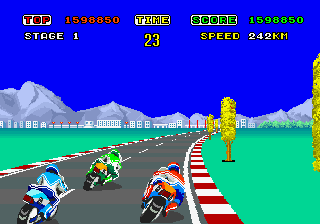
Hang-On is the 1985 project in which Yu Suzuki's SEGA team transformed motorcycle racing into a physical arcade experience. Full-size versions let the rider steer by leaning a motorcycle-shaped cabinet. The corner on screen is therefore connected directly and visibly to the player's shifting body weight.
Holding the Racing Line
Throttle, brake, and lean appear simple, but the real challenge is holding the correct line without losing speed. Leaving the road reduces momentum, while contact with rival bikes destroys valuable seconds. Time gates turn each section into a short performance test with its own rhythm.
A Horizon Built from Scaled Sprites
The Super Scaler approach enlarges motorcycles and roadside objects rapidly as they move from horizon to foreground. Road undulation and corner flow create forceful forward motion despite a fixed camera. Engine pitch and pressure in the sound design mentally complete the physical presence of the cabinet.
Experience Design Through Arcade Hardware
Hang-On matters not merely as a motorcycle game but because its cabinet becomes a performance device entered by the player rather than a machine watched from a distance. I see it as an early SEGA example of screen, control surface, and body jointly defining a game's identity.
Sources and scope
- SEGA — Company history
A source link retained from the previous edition. A general company page does not verify a specific historical claim.
- Arcade Database — Hang-On
A source link retained from the previous edition. A general company page does not verify a specific historical claim.
- Arcade Database — hangon
Metadata provenance link; cached fields were not freshly recrawled from that site in this revision.
Read alongside
This is neither a distribution license nor a play-test report. Public game access requires separate verification of the applicable rights.