

SOURCE-LED ANALYSIS
Tetris: designing the empty space too
Separating the design’s 1984 origin from the 1988 Atari Games catalog record while examining placement, gaps and accumulated decisions.
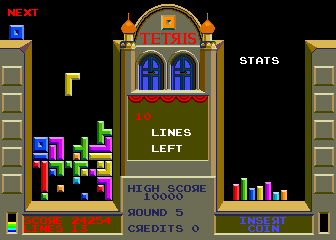
Catalog data — identifies the version
- Catalog year
- 1988
- Manufacturer
- Atari Games
- Genre
- Puzzle / Drop
- Metadata players
- 2
- Set ID
- atetris
- Cached status
- GOOD
These fields come from the existing metadata cache dated 30 July 2026. Player count does not promise simultaneous online play, and emulation status is not a test result from this device.
Compare in the catalog →Two dates, two different questions
The official Tetris page identifies the design’s origin as 1984 and Alexey Pajitnov. The 1988 date in Cinarverse’s atetris record is metadata for an Atari Games arcade set. One answers “where did the design originate?” and the other “which release does this record document?” Combining them into a claim that Atari invented Tetris in 1988 would be wrong. Version distinction is fundamental to an accurate archive.
Reading the gap left by a piece
The basic rule is to place falling pieces and complete horizontal rows. An action’s result is not merely the squares filled: the new shape of empty space affects future decisions too. I read the design as requiring attention to negative space as well as objects. Fitting a piece and leaving a legible space for future pieces are not the same criterion of success.
Persistent traces of decisions
A move leaves a trace in the playing field, and the next move occurs within that trace. This creates a different structure of time from winning or losing through one isolated action. The player manages both the incoming object and a space shaped by past decisions. An interface lesson is to keep previous actions’ consequences visible: concealing them makes future constraints harder to understand.
Modern Tetris rules are not assumed here
Hold, ghost-piece or rotation systems in a modern release are not assumed to exist identically in the older arcade version. This dossier focuses on basic placement reasoning and does not claim verification of all atetris-specific rules. Check the set and version before applying a control guide. A shared title does not establish identical input feel or scoring.
A comparison exercise for the reader
In a licensed version, compare two placements not only by completed rows but by how understandable the remaining space is. Which makes the next decision easier to describe? This is neither an optimal strategy nor a success guarantee. It separates a move’s immediate appearance from its longer-term effect on the field. No player experiment, success rate or device-latency measurement is reported here; those require real records.
Space decisions · interactive comparison
Explore two example stack layouts. This is not a game screenshot, recorded test or simulation of a particular Tetris release.
Method: An empty cell counts as covered if an occupied cell exists above it in the same column. Line clears, actual piece physics and scoring are not modeled.
Decision map
| Element | Function | Interpretation |
|---|---|---|
| 1984 | Design origin | Official Tetris source |
| 1988 | Arcade set year | Cached metadata |
| Placement | Present action | Consequence for future space |
Limits of the credit information
The underlying Tetris design is by Alexey Pajitnov; the official Tetris page identifies its 1984 origin. Atari Games in this catalog is version metadata for the arcade set.
Sources and scope
- Tetris — About Tetris
Pajitnov, 1984 origin and basic placement/line completion rules, not Atari arcade-specific systems.
- The Strong — Tetris
Historical and cultural context for Tetris.
- Arcade Database — atetris
Metadata provenance link; cached fields were not freshly recrawled from that site in this revision.
Read alongside
This is neither a distribution license nor a play-test report. Public game access requires separate verification of the applicable rights.