

SHORT DESIGN NOTE
Arkanoid
A design reading of Arkanoid’s paddle-and-ball control, now including an original interactive reflection experiment.
The historical team credits and all external sources of this short note were not reverified in this revision. Do not read interpretation as a measured play test.
Catalog data — identifies the version
- Catalog year
- 1986
- Manufacturer
- Taito Corporation Japan
- Genre
- Ball & Paddle / Breakout
- Metadata players
- 2
- Set ID
- arkanoid
- Cached status
- GOOD
These fields come from the existing metadata cache dated 30 July 2026. Player count does not promise simultaneous online play, and emulation status is not a test result from this device.
Compare in the catalog →Adding Adventure to the Breakout Formula
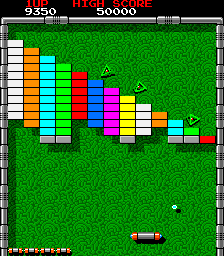
Taito's 1986 Arkanoid sends the Vaus spacecraft through block fields controlled by DOH. Breakout's ball-and-paddle foundation remains, while enemies, varied block materials, power capsules, and a boss encounter are added. An abstract score game becomes a science-fiction journey with a beginning and an end.
Angle Control Through the Spinner
A spinner moves the Vaus precisely along the horizontal axis. The point of contact affects the ball's return angle, so strong play means choosing where to meet it rather than merely reaching it. As speed rises, balancing broad movement with tiny correction becomes the heart of physical control.
Rules That Change Through Capsules
Wide paddle, multiball, laser, slow, catch, and exit capsules transform the same stage into different strategies. Some increase safety, while the laser attacks independently of ball control. Collecting a new capsule can replace the current power, so a visible reward is not automatically the correct choice.
Stage Variety from One Geometry
Arkanoid turns the same rectangular field into many rhythms through block placement, durability, and enemy interference. The ball's path continually travels between player decision and environment design. I see it as an example of a classic mechanical core gaining near-genre-level richness through precise control and meaningful power-ups.
CINARVERSE · V17.49 · INTERACTIVE LAB
Ball Physics & Bounce Angles Lab
A ball striking the center or the edge of a paddle can leave in different directions, even at the same speed. Adjust the contact point to compare wall rebounds and where the path reaches the upper field.
Changing speed affects the animation time, not the path geometry.
A central impact produces a nearly vertical return in this model, typically without wall rebounds.
Choose a contact position and press Launch ball.
This is an educational geometric model: contact position changes angle, while speed changes animation duration. It does not reproduce Arkanoid’s actual code, collision rules, or level layout.
Use arrow keys for sliders or tap the controls.
Sources and scope
- Taito — Arkanoid
A source link retained from the previous edition. A general company page does not verify a specific historical claim.
- Arcade Database — Arkanoid
A source link retained from the previous edition. A general company page does not verify a specific historical claim.
- Arcade Database — arkanoid
Metadata provenance link; cached fields were not freshly recrawled from that site in this revision.
Read alongside
This is neither a distribution license nor a play-test report. Public game access requires separate verification of the applicable rights.