

SHORT DESIGN NOTE
Tempest
Tempest — Release verification and design analysis; 1981.
The historical team credits and all external sources of this short note were not reverified in this revision. Do not read interpretation as a measured play test.
Catalog data — identifies the version
- Catalog year
- 1980
- Verified original arcade release
- 1981
- Manufacturer
- Atari
- Genre
- Shooter / Gallery
- Metadata players
- 2
- Set ID
- tempest
- Cached status
- GOOD
These fields come from the existing metadata cache dated 30 July 2026. Player count does not promise simultaneous online play, and emulation status is not a test result from this device.
Compare in the catalog →Reading the archive year and release date
The “catalog year” on this page is preserved from the metadata cache dated 30 July 2026. The documented original arcade release is shown separately. These are different kinds of records; the older value is not silently overwritten.
A Shooter Looking into the Tube
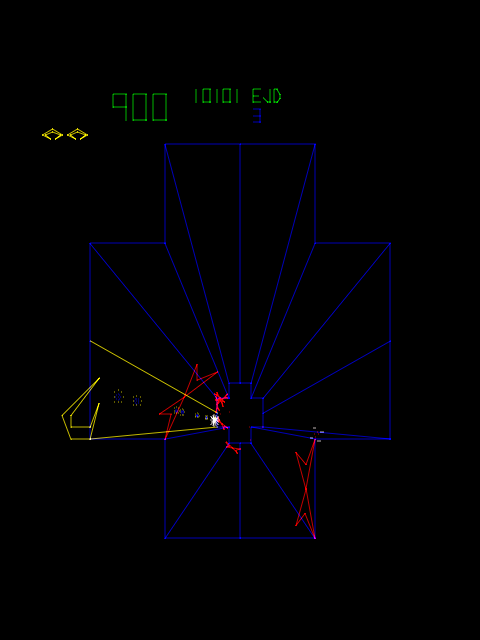
Dave Theurer's 1981 Tempest places the player on the rim of a three-dimensional geometry drawn in color vectors. Enemies climb outward from the depth of the tube while the player moves around its edge. Perspective turns approach time into visible spatial distance.
Circular Motion Through the Spinner
The spinner moves the claw rapidly and precisely among the tube's lanes. Because fire is directed toward the center, every lane becomes a separate attack corridor. The Superzapper can clear an emergency but its limited use turns panic into a planned resource. Even the transition between stages becomes an escape challenge of its own.
Color as Depth Information
Tempest uses color vector technology for more than spectacle. Enemy types, projectiles, and stage geometry remain legible through sharp color separation. As lines move in black space, the player completes the tube's shape mentally. Electronic audio aligns approach, contact, and transition speed with the visual perspective.
The Physical Feel of Abstract Space
There is no realistic vehicle or environment, yet spinner resistance, lanes, and depth create a strong physical sense of direction. For me, Tempest demonstrates that abstract graphics need not feel cold; aligned with the right control surface, they can become an immersive physical space.
A design decision worth examining
Tempest places the player around the edge of a tube while enemies advance from its center. Threats are read through their lane and distance rather than as simple left-to-right movement.
Compare waiting in one lane with circling the rim to intercept targets early. Vector lines serve as distance and approach cues, not merely decoration.
Direct source for the arcade release year
Atari Coin Connection — October 1981
The linked source supports the original arcade release year. The design discussion below is Cinarverse editorial interpretation, not a measured play test.
Sources and scope
- Atari — Tempest Origins (1981)
- The Strong Museum — Tempest
A source link retained from the previous edition. A general company page does not verify a specific historical claim.
- Atari — Tempest
A source link retained from the previous edition. A general company page does not verify a specific historical claim.
- Arcade Database — tempest
Metadata provenance link; cached fields were not freshly recrawled from that site in this revision.
Read alongside
This is neither a distribution license nor a play-test report. Public game access requires separate verification of the applicable rights.