

SHORT DESIGN NOTE
Centipede
Centipede — Release verification and design analysis; 1981.
The historical team credits and all external sources of this short note were not reverified in this revision. Do not read interpretation as a measured play test.
Catalog data — identifies the version
- Catalog year
- 1980
- Verified original arcade release
- 1981
- Manufacturer
- Atari
- Genre
- Shooter / Gallery
- Metadata players
- 1
- Set ID
- centiped
- Cached status
- GOOD
These fields come from the existing metadata cache dated 30 July 2026. Player count does not promise simultaneous online play, and emulation status is not a test result from this device.
Compare in the catalog →Reading the archive year and release date
The “catalog year” on this page is preserved from the metadata cache dated 30 July 2026. The documented original arcade release is shown separately. These are different kinds of records; the older value is not silently overwritten.
Defending a Mushroom Garden
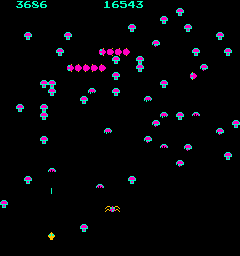
Designed by Ed Logg and Dona Bailey, Centipede arrived in Atari arcades in 1981. The centipede changes direction and descends whenever it hits a mushroom, so earlier shots also reshape its future path. Spiders, fleas, and scorpions disturb the field from different directions, turning a simple shooter into a living ecosystem.
Speed and Precision Through the Trackball
The trackball allows rapid horizontal and limited vertical motion within the lower field. Unlike fixed joystick steps, hand acceleration translates directly into escape on screen. That physical relationship makes last-second gaps possible among descending segments, while panicked movement can still undermine aim.
Colorful Readability
Centipede's pastel and neon colors are not merely aesthetic. Each creature communicates a distinct behavior through color, size, and movement path. The mushroom field becomes a map of the player's earlier decisions. Even at high density, the screen does not feel arbitrary because the formation of danger can be read backward visually.
Between Accessibility and Depth
One fire button and direct movement provide immediate access, while mushroom clearing, scorpion poison, and scoring risk create long-term strategy. I see Centipede as an important Atari design showing that an inclusive control surface and expert-level systemic depth can occupy the same cabinet.
A design decision worth examining
Destroying a mushroom in Centipede does more than clear the immediate playfield: it can change the path the centipede takes later. A shot is therefore both an immediate reaction and a decision about future space.
Compare continuous fire at a visible target with preserving an escape route near the bottom. The first favors the moment; the second anticipates a position the player may need seconds later.
Direct source for the arcade release year
The Strong National Museum of Play — Centipede
The linked source supports the original arcade release year. The design discussion below is Cinarverse editorial interpretation, not a measured play test.
Sources and scope
- The Strong — Centipede (1981)
- The Strong Museum — Centipede
A source link retained from the previous edition. A general company page does not verify a specific historical claim.
- Atari — Centipede
A source link retained from the previous edition. A general company page does not verify a specific historical claim.
- Arcade Database — centiped
Metadata provenance link; cached fields were not freshly recrawled from that site in this revision.
Read alongside
This is neither a distribution license nor a play-test report. Public game access requires separate verification of the applicable rights.