

SHORT DESIGN NOTE
Defender
Defender — Release verification and design analysis; 1981.
The historical team credits and all external sources of this short note were not reverified in this revision. Do not read interpretation as a measured play test.
Catalog data — identifies the version
- Catalog year
- 1980
- Verified original arcade release
- 1981
- Manufacturer
- Williams
- Genre
- Shooter / Flying Horizontal
- Metadata players
- 1
- Set ID
- defender
- Cached status
- GOOD
These fields come from the existing metadata cache dated 30 July 2026. Player count does not promise simultaneous online play, and emulation status is not a test result from this device.
Compare in the catalog →Reading the archive year and release date
The “catalog year” on this page is preserved from the metadata cache dated 30 July 2026. The documented original arcade release is shown separately. These are different kinds of records; the older value is not silently overwritten.
Constant Crisis in a Horizontal World
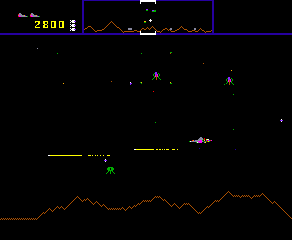
Williams' 1981 Defender is a high-speed horizontal shooter developed under the lead of Eugene Jarvis and Larry DeMar. The player does more than destroy enemies: humans on the planet surface must be protected from abduction while threats at both ends are monitored through radar. That responsibility creates the feeling of a world continuing beyond the visible screen.
Mastery Through the Control Panel
The joystick is joined by separate commands for fire, thrust, reverse, hyperspace, and smart bomb. Intimidating at first contact, the dense panel eventually allows very fast decisions to be executed directly. The reverse button instantly changes the ship's facing direction, shortening the transition between escape and attack.
Radar as a Second Playfield
The radar is not a decorative map; it is a second playfield showing abducted humans, enemy clusters, and emerging crises. The player reads close-range shooting and the global situation simultaneously. Audio warnings support that information load, identifying danger even when the eye is focused elsewhere.
Why Extreme Difficulty Can Feel Fair
Defender is punishing, yet failure usually emerges from a readable system: poor priorities, late radar checks, or mistimed reversals. Every attempt teaches the player to process more information. I use this game to show that complex controls are not inherently flawed when consistency turns them into a powerful space for mastery.
A design decision worth examining
In Defender, the radar can reveal danger far beyond the portion of the world currently visible. Focusing only on nearby enemies may leave the humans elsewhere exposed.
Compare shooting the nearest target with reversing direction after a radar warning. Pressure comes not just from fast shots, but from dividing attention across the wider world.
Direct source for the arcade release year
The Strong National Museum of Play — Defender
The linked source supports the original arcade release year. The design discussion below is Cinarverse editorial interpretation, not a measured play test.
Sources and scope
- The Strong — Defender (1981)
- The Strong Museum — Defender
A source link retained from the previous edition. A general company page does not verify a specific historical claim.
- Arcade Database — Defender
A source link retained from the previous edition. A general company page does not verify a specific historical claim.
- Arcade Database — defender
Metadata provenance link; cached fields were not freshly recrawled from that site in this revision.
Read alongside
This is neither a distribution license nor a play-test report. Public game access requires separate verification of the applicable rights.