

SHORT DESIGN NOTE
Smash T.V.
A short design note from the previous edition; not a new play-test report.
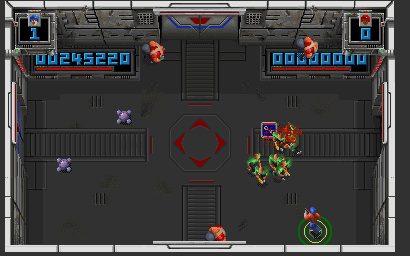
The historical team credits and all external sources of this short note were not reverified in this revision. Do not read interpretation as a measured play test.
Catalog data — identifies the version
- Catalog year
- 1990
- Manufacturer
- Williams
- Genre
- Shooter / Field
- Metadata players
- 2
- Set ID
- smashtv
- Cached status
- GOOD
These fields come from the existing metadata cache dated 30 July 2026. Player count does not promise simultaneous online play, and emulation status is not a test result from this device.
Compare in the catalog →The Arena as a Television Game Show
Eugene Jarvis and Mark Turmell's Smash T.V. framed lethal arena combat as an aggressively consumerist television game show in 1990. Players fight waves for cash, appliances, and vacations. The deliberate mismatch between announcer enthusiasm and violence establishes the game's black comedy.
Robotron's Legacy in a Room System
Dual joysticks separate movement from fire, but connected rooms replace Robotron's single-wave arena. Players choose routes, divert toward prize rooms, and prepare for bosses. Limited space, enemy entry points, and temporary weapons turn every room into a compact tactical puzzle.
Turning Screen Density into Reward
Projectile and enemy density is extreme, while weapon upgrades provide short bursts of overwhelming power. Large cash icons and bright prizes are placed inside danger, so score desire disrupts safe routes. The announcement “Big money, big prizes” becomes a slogan for the mechanical risk itself.
Enjoying and Critiquing the Spectacle
Smash T.V. critiques violent spectacle while delivering its mechanical pleasure with full force. Players willingly take risks for the rewards being mocked. I see it as an example of theme and player behavior reinforcing one another through contradiction, bringing spectator culture directly into play.
Sources and scope
- Arcade Database — Smash T.V.
A source link retained from the previous edition. A general company page does not verify a specific historical claim.
- The Strong Museum — Eugene Jarvis
A source link retained from the previous edition. A general company page does not verify a specific historical claim.
- Arcade Database — smashtv
Metadata provenance link; cached fields were not freshly recrawled from that site in this revision.
Read alongside
This is neither a distribution license nor a play-test report. Public game access requires separate verification of the applicable rights.