

SHORT DESIGN NOTE
Robotron: 2084
A short design note from the previous edition; not a new play-test report.
The historical team credits and all external sources of this short note were not reverified in this revision. Do not read interpretation as a measured play test.
Catalog data — identifies the version
- Catalog year
- 1982
- Manufacturer
- Williams / Vid Kidz
- Genre
- Shooter / Field
- Metadata players
- 1
- Set ID
- robotron
- Cached status
- GOOD
These fields come from the existing metadata cache dated 30 July 2026. Player count does not promise simultaneous online play, and emulation status is not a test result from this device.
Compare in the catalog →Two Joysticks, One Language of Reflex
Robotron: 2084 is a single-screen arena shooter designed by Eugene Jarvis and Larry DeMar for Williams in 1982. One joystick controls movement and the other fires in eight directions. Separating locomotion from aim may feel familiar today, but it was a radical idea that allowed simultaneous escape and counterattack.
Reading Crowds as Shapes
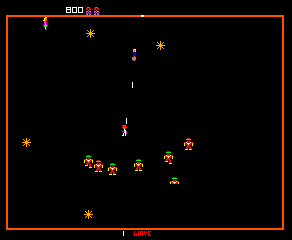
Each wave surrounds the player with threats that behave differently. Grunts close directly, Hulks occupy space, Brains convert humans, and Enforcers apply ranged pressure. Success depends on reading the crowd's overall shape, creating an escape lane, and taking controlled risks toward endangered family members rather than fixating on one target.
Readable Science-Fiction Noise
Although the screen fills with enemies, projectiles, and particles, bright color groups keep roles distinguishable. Continuous electronic effects reinforce approaching danger and successful rescue. The visual chaos is not random; it is a layered information system directing attention toward the center, safe gaps, and suddenly vulnerable high-value humans.
The Root of Twin-Stick Design
Robotron's control concept directly influenced later arena shooters and console games built around dual analog sticks. Its legacy also lies in making many enemy behaviors readable at once. I see it as a model for how careful role design can turn overwhelming density into clarity.
Sources and scope
- The Strong Museum — Robotron: 2084
A source link retained from the previous edition. A general company page does not verify a specific historical claim.
- Arcade Database — Robotron
A source link retained from the previous edition. A general company page does not verify a specific historical claim.
- Arcade Database — robotron
Metadata provenance link; cached fields were not freshly recrawled from that site in this revision.
Read alongside
This is neither a distribution license nor a play-test report. Public game access requires separate verification of the applicable rights.