

SOURCE-LED ANALYSES
Rally-X: reading the road and the radar together
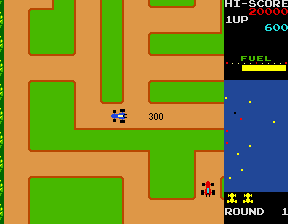
Rally-X divides information between a nearby road and a wider map. I read good route planning as a conversation between those two views.
Game profile
- Catalog year
- 1980
- Manufacturer
- Namco
- Genre
- Maze / Driving
- Metadata players
- 2
- Set ID
- rallyx
Two views answer two questions
The road view helps answer whether the next turn is possible, while the radar places that turn within a wider route. I would not ask either view to do the other's work. The useful movement of attention is between immediate space and the next destination. A map can be accurate and still be unhelpful if consulted at the wrong moment.
A flag is a destination, not a whole plan
The licensed publisher describes collecting flags while avoiding red cars. I read the task as more than a succession of nearby targets. A tempting destination can leave an awkward route out, while a less direct approach can preserve another junction. The next flag matters together with the route that will remain after it is reached.
Smoke buys a local opportunity
Smoke changes an immediate pursuit problem, but it does not choose the next intersection for the player. I regard it as an intervention within a route rather than a substitute for planning. Its value depends on what can be done with the resulting room. A temporary opening becomes useful when it connects to a coherent next move.
Keep the map within reach of the eye
Shrinking the game image can make the radar seem like a minor accessory. For this design reading, it is part of the decision surface. I would preserve the relationship between the small map and the road instead of enlarging one while obscuring the other. A useful interface keeps both local danger and overall direction legible.
Three questions I ask while looking
- What can the radar tell us that the road view cannot?
- Which exit remains after reaching the flag?
- What next turn makes the smoke-created opening useful?
Sources and scope
HAMSTER's licensed Arcade Archives page supports flags, pursuit and smoke. The two-view route analysis is my interpretation; fuel costs, timing and opponent algorithms are not presented as measured findings.