

SHORT DESIGN NOTE
Ms. Pac-Man
A short design note from the previous edition; not a new play-test report.
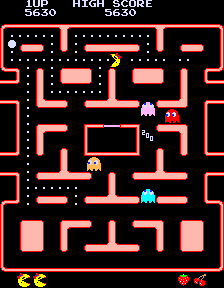
The historical team credits and all external sources of this short note were not reverified in this revision. Do not read interpretation as a measured play test.
Catalog data — identifies the version
- Catalog year
- 1981
- Manufacturer
- Midway / General Computer Corporation
- Genre
- Maze / Collect
- Metadata players
- 2
- Set ID
- mspacman
- Cached status
- GOOD
These fields come from the existing metadata cache dated 30 July 2026. Player count does not promise simultaneous online play, and emulation status is not a test result from this device.
Compare in the catalog →From Modification to Standalone Classic
Ms. Pac-Man grew from General Computer Corporation's Crazy Otto enhancement project for Pac-Man and reached arcades through Midway in 1982. The new lead character was more than a visual substitution: multiple mazes, moving fruit, and less predictable ghost behavior turned the project into a distinct sequel rather than a cosmetic revision.
Between Memory and Instinct
The goal remains collecting dots while evading four ghosts, but rotating among four maze layouts makes reliance on one safe route far less effective. Tunnel speed, the brief advantage of power pellets, and ghost distribution demand new decisions at every turn. The result preserves Pac-Man's readable rules while disrupting memorized play more often.
Character and Intermission Language
Its changing palettes, varied mazes, and brief intermissions give Ms. Pac-Man a strong identity. Sequences such as “They Meet,” “The Chase,” and “Junior” insert a miniature relationship story between mechanical challenges. Built from only a few sprites and captions, they demonstrate how arcade characters could create attachment without interrupting play for long.
A Standard for Sequel Design
The game proves that a sequel need not discard a successful rule set in order to expand it. Small, targeted changes renew route planning, replay value, and character identity together. I read Ms. Pac-Man as a lesson in how carefully placed variation can create independence without simply adding more content.
Ms. Pac-Man: route and risk lab
The shortest route through a maze is not always the best choice. Move the ghost and adjust how much danger matters; compare a shortest path with a risk-aware alternative.
Tap or click an open tile to choose another destination.
Try priority settings 1 and 5: when does a detour become worthwhile?
An original, simplified Cinarverse maze model—not an authentic Ms. Pac-Man map, ghost AI, scoring system, or gameplay measurement. Hazard is estimated from Manhattan distance to a stationary ghost. Research context: navigation and moving threats in Ms. Pac-Man.
Sources and scope
- ACMI — Ms Pac-Man arcade cabinet (1982)
- The Strong Museum — Ms. Pac-Man
A source link retained from the previous edition. A general company page does not verify a specific historical claim.
- Internet Archive — GCC history
A source link retained from the previous edition. A general company page does not verify a specific historical claim.
- Arcade Database — mspacman
Metadata provenance link; cached fields were not freshly recrawled from that site in this revision.
Read alongside
This is neither a distribution license nor a play-test report. Public game access requires separate verification of the applicable rights.