

SHORT DESIGN NOTE
Missile Command
A short design note from the previous edition; not a new play-test report.
The historical team credits and all external sources of this short note were not reverified in this revision. Do not read interpretation as a measured play test.
Catalog data — identifies the version
- Catalog year
- 1980
- Manufacturer
- Atari
- Genre
- Shooter / Command
- Metadata players
- 2
- Set ID
- missile
- Cached status
- GOOD
These fields come from the existing metadata cache dated 30 July 2026. Player count does not promise simultaneous online play, and emulation status is not a test result from this device.
Compare in the catalog →A Defense That Cannot Be Won
Designed by Dave Theurer, Missile Command placed the player in charge of protecting six cities from ballistic attack in 1980. Yet it offers no final victory; waves accelerate until the defense eventually collapses. The high-score pursuit becomes an effort to postpone inevitable loss rather than a conventional heroic triumph.
Limited Ammunition, Delayed Detonation
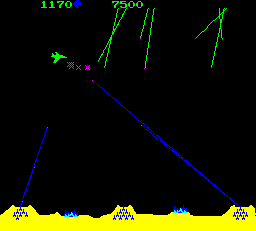
The three missile bases have limited ammunition, and every defensive missile takes time to reach its target. The player aims not at an enemy but at the location where an explosion will cover the most threats seconds later. Chain reactions create efficiency, while hurried shots leave the next moments undefended.
Strategic Marking with a Trackball
The trackball moves a cursor rapidly across the sky, while three fire buttons select the launching base. Target and resource are therefore chosen at once. Minimal city silhouettes and rising missile trails make consequences unmistakable; every destroyed city permanently changes the balance of the screen.
Mechanics of Cold War Anxiety
Missile Command communicates its theme not through exposition but through exhausting defense. “The End” frames game over as a catastrophe broader than personal defeat. I treat it as a powerful example of historical anxiety translated directly into resource management and inevitability.
Sources and scope
- The Strong Museum — Missile Command
A source link retained from the previous edition. A general company page does not verify a specific historical claim.
- Atari — Missile Command
A source link retained from the previous edition. A general company page does not verify a specific historical claim.
- Arcade Database — missile
Metadata provenance link; cached fields were not freshly recrawled from that site in this revision.
Read alongside
This is neither a distribution license nor a play-test report. Public game access requires separate verification of the applicable rights.