

SHORT DESIGN NOTE
Gradius III
A short design note from the previous edition; not a new play-test report.
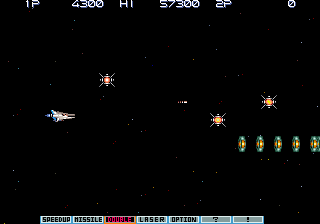
The historical team credits and all external sources of this short note were not reverified in this revision. Do not read interpretation as a measured play test.
Catalog data — identifies the version
- Catalog year
- 1989
- Manufacturer
- Konami
- Genre
- Shooter / Flying Horizontal
- Metadata players
- 2
- Set ID
- gradius3
- Cached status
- GOOD
These fields come from the existing metadata cache dated 30 July 2026. Player count does not promise simultaneous online play, and emulation status is not a test result from this device.
Compare in the catalog →A Large-Scale Journey for the Vic Viper
Gradius III was released by Konami in 1989, sending the Vic Viper on a long, multi-themed campaign against Bacterion forces. Desert, crystal, fire, and organic stages do more than change scenery; they rebuild projectile motion and safe-route logic. The game tests the established series system through greater stage density.
A Personal Upgrade Order Through the Power Meter
Collected capsules advance a cursor through speed, missile, double, laser, Option, and shield stages. Activating the meter selects that upgrade and resets the sequence. Arcade configuration choices allow players to personalize equipment priority before a dangerous stage begins.
Turning Movement History into Firepower
Option satellites follow the ship's previous movement path and fire simultaneously. The history of player position therefore becomes an attack formation. In narrow spaces, arranging Options along the correct line matters as much as evasion. Losing upgrades after death makes rebuilding that formation the game's harshest test.
The Design Cost of Excess
Gradius III offers impressive stage variety and music while remaining notorious for severe difficulty. Hardware slowdown can alter projectile density and become part of the arcade experience. I treat it as evidence that increasing sequel scale creates a real design cost in both visual richness and accessibility.
Sources and scope
- Konami — Games
A source link retained from the previous edition. A general company page does not verify a specific historical claim.
- Arcade Database — Gradius III
A source link retained from the previous edition. A general company page does not verify a specific historical claim.
- Arcade Database — gradius3
Metadata provenance link; cached fields were not freshly recrawled from that site in this revision.
Read alongside
This is neither a distribution license nor a play-test report. Public game access requires separate verification of the applicable rights.