

SOURCE-LED ANALYSES
Dragon Buster: the journey begins before the encounter
I read Dragon Buster through the relationship between choosing a destination and facing what lies inside it. The journey is a sequence of commitments, not just a final dragon.
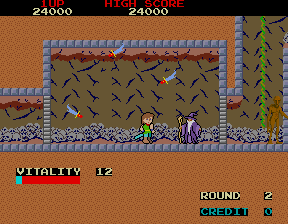
Game profile
- Catalog year
- 1984
- Manufacturer
- Namco
- Genre
- Platform / Fighter Scrolling
- Metadata players
- 2
- Set ID
- drgnbstr
A destination changes the question
A route towards a distant goal creates a different kind of decision from the next jump or attack. I like to ask what a destination promises before considering how to cross its interior. This keeps the broader journey visible. An action game can offer planning without asking the player to stop thinking about immediate movement.
Sword and magic imply different distances
The licensed publisher identifies both swordplay and magic. I read the pairing as two ways to imagine an encounter: entering nearby space or influencing a threat at a distance. The interesting question is what each option allows the character to avoid or approach. This is a spatial comparison, not a list of verified damage values.
The final goal gives smaller places meaning
The official description names ruins and graveyards on the way to Dragon Mountain. I read these places as stages in a journey rather than unrelated backgrounds. Their relation to the destination gives an ordinary passage a reason to matter. The story becomes useful when it helps the player understand why the next movement belongs to a larger task.
A map cannot explain every commitment
A wider view can suggest a route, but the interior of a place supplies the immediate obstacles. I would keep those kinds of information separate when reading the design. A promising destination still needs a workable encounter plan. Dragon Buster gives me a way to discuss how action and journey planning can share responsibility without one replacing the other.
Three questions I ask while looking
- What makes this destination worth approaching?
- Which distance suits the available attack?
- How does the local encounter change the plan for the wider journey?
Sources and scope
HAMSTER's licensed record dates the original to 1984 and describes sword, magic and the journey to Dragon Mountain. The route interpretation is mine; it is not a claim of historical priority or a complete walkthrough.