

SHORT DESIGN NOTE
Ghosts'n Goblins
A short design note from the previous edition; not a new play-test report.
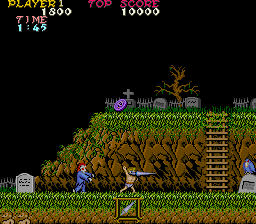
The historical team credits and all external sources of this short note were not reverified in this revision. Do not read interpretation as a measured play test.
Catalog data — identifies the version
- Catalog year
- 1985
- Manufacturer
- Capcom
- Genre
- Platform / Fighter Scrolling
- Metadata players
- 2
- Set ID
- gng
- Cached status
- GOOD
These fields come from the existing metadata cache dated 30 July 2026. Player count does not promise simultaneous online play, and emulation status is not a test result from this device.
Compare in the catalog →Two Hits Beneath the Armor
Directed by Tokuro Fujiwara, Ghosts'n Goblins sent the knight Arthur on a demonic rescue mission in 1985. The first hit removes his armor and the second takes his life. That visual transformation communicates health without a meter while establishing the game's tone between comedy and severity.
Commitment Through a Fixed Jump
Arthur cannot easily redirect in the air; once a jump begins, the decision is largely committed. Enemies arrive from ground, sky, and behind, forcing preparation before the screen scrolls. Weapon arcs and on-screen persistence mean that a poor pickup can complicate the rhythm of an entire section.
A Colorful Theater of Horror Icons
Cemeteries, forests, ice caves, and castles rearrange horror imagery through bright color. Enemies such as the Red Arremer break simple movement patterns by reacting to player intent. Ayako Mori's compact musical motifs carry both fairy-tale adventure and the tension of repeated attempts.
Difficulty That Produces Memory
The famous second-loop requirement does not simply invalidate the first completion; it tests the learned route again under renewed pressure. The game can be severe, but stage knowledge is the real progression. I treat Ghosts'n Goblins as an emblem of arcade design turning player memory into invisible equipment.
Sources and scope
- Capcom — Ghosts 'n Goblins
A source link retained from the previous edition. A general company page does not verify a specific historical claim.
- Arcade Database — Ghosts'n Goblins
A source link retained from the previous edition. A general company page does not verify a specific historical claim.
- Arcade Database — gng
Metadata provenance link; cached fields were not freshly recrawled from that site in this revision.
Read alongside
This is neither a distribution license nor a play-test report. Public game access requires separate verification of the applicable rights.