

SOURCE-LED ANALYSIS
Donkey Kong: goal, route and danger on one screen
Nearby ladders, usable exits and scoring goals in Donkey Kong: two route diagrams, Nintendo’s description and an original cabinet manual.
Updated ·
Catalog data — identifies the version
- Catalog year
- 1981
- Manufacturer
- Nintendo of America
- Genre
- Platform / Run Jump
- Metadata players
- 2
- Set ID
- dkong
- Cached status
- GOOD
These fields come from the existing metadata cache dated 30 July 2026. Player count does not promise simultaneous online play, and emulation status is not a test result from this device.
Compare in the catalog →Historical context, not an inflated “first” claim
The Strong connects development of Donkey Kong to Nintendo’s need for a new game after Radar Scope in 1981, identifying Miyamoto’s central role. It also describes scenes in which the player crosses obstacles toward a rescue. Those are the historical anchors used here. We do not declare the game the uncontested first example of every platform or narrative category. Importance does not require being first in all respects.
The screen is also a sentence of the story
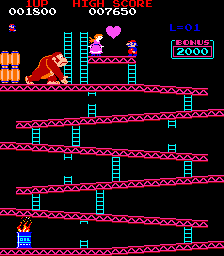
Placing the goal above the player communicates where to go without a text box. Platforms and ladders between them turn the narrative into a routing problem. I read the protagonist’s intention as part of the scene composition. Understanding why a character moves and knowing which button moves it are different kinds of learning; a well-composed scene can communicate the former directly.
A ladder: shortcut or commitment?
Seeing a ladder merely as a line between heights misses half the decision. Climbing means temporarily giving up options on the current platform, so route and timing should be considered together. This is not a claim about a particular barrel’s exact algorithm. In a licensed version, comparing the options available before entering a ladder and during the climb offers a way to examine this interpretation.
Visible progress on a small screen
A single-screen scene can show proximity to the goal without a separate mission map. When that scene shrinks, however, gaps between character and danger can become ambiguous. Surrounding a browser game with many controls can also shrink its narrative map. The useful criterion is not simply whether the picture fits, but whether distinctions needed for decisions remain readable.
Is the nearest ladder the best exit?
In this three-level example I place the player below and the goal above. An obstacle sits at the top of the nearer ladder; the longer route reaches a different exit. Counting only the distance to a ladder misses the decision immediately afterwards. I first ask what space I will enter when the climb ends. The diagram does not copy a Donkey Kong stage or describe the algorithm by which barrels choose ladders. It compares routes to show why proximity and a usable landing are different criteria.
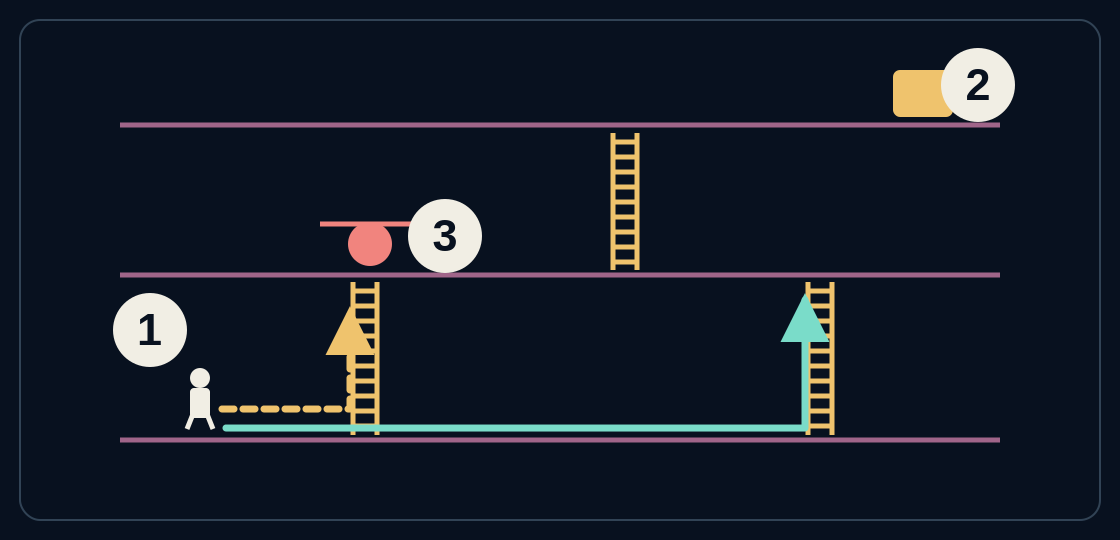
- 1Player’s starting position
- 2Goal on the upper level
- 3Illustrative obstacle at the nearer ladder’s exit
Scoring and climbing
Nintendo’s TKG-2-UP cabinet manual makes the extra Jumpman score threshold adjustable. That cabinet document does not establish this ROM set’s settings.
Both panels put the goal in the same place. On the left, a hammer and nearby barrel suggest a scoring opportunity; on the right, the ladder leads upwards. Nintendo’s official description confirms that destroying barrels and fire with the hammer earns points. I use that rule to distinguish earning something from the present encounter and approaching the rescue goal. Success at one does not automatically settle the other. The manual’s adjustable extra-life threshold also provides a concrete reason to check the assumption that the same score always brings the same reward on every cabinet.
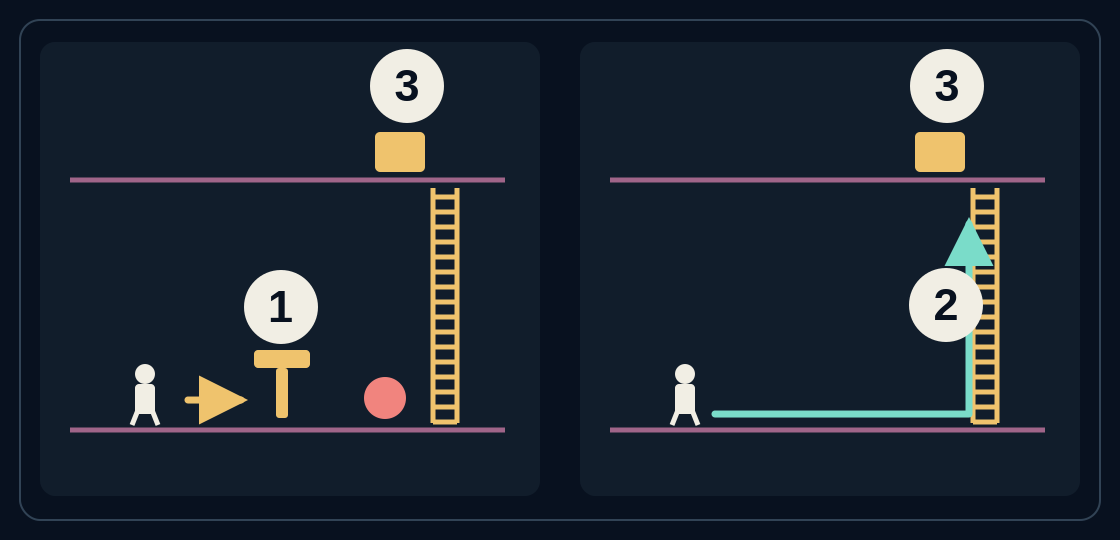
- 1Hammer and scoring opportunity
- 2Route to the upper level
- 3The same goal in both panels
An observation exercise for the reader
Try locating the goal first, the next ladder second and the nearest hazard last. Does reversing that viewing order change your route decision? This is not a high-score trick; it examines how the scene orders information. I publish no completed play-session or mobile success-rate result for this page. The interpretation should stand on a question the reader can examine, not on invented experience.
Decision map
| Element | Function | Interpretation |
|---|---|---|
| Goal | Where? | Destination above |
| Ladder | Which route? | Commitment to a transition |
| Hazard | When? | Read position and timing together |
Limits of the credit information
The Strong’s Donkey Kong record identifies Shigeru Miyamoto’s development role. This is not presented as a complete production roster.
Sources and scope
- The Strong — Donkey Kong
1981 context, Miyamoto, ladders and obstacles, and the four-scene narrative.
- Arcade Database — dkong
Metadata provenance link; cached fields were not freshly recrawled from that site in this revision.
Verified claims and sources
- Nintendo / HAMSTER · Arcade Archives Donkey Kong
- Claim
- Construction-site rescue goal; points for destroying barrels and fire with a hammer.
- Evidence
- Game description; original game 1981, this rerelease 2018
- Nintendo · Donkey Kong cabinet manual (TKG-2-UP)
- Claim
- Cabinet switches set the extra Jumpman score threshold; this is not a browser test.
- Evidence
- Archived original · printed p. 5 / PDF p. 6 · CPU P.C. Board
Numbered drawings are Cinarverse explanatory diagrams, not game screenshots or recorded play tests.
Read alongside
This is neither a distribution license nor a play-test report. Public game access requires separate verification of the applicable rights.