

SHORT DESIGN NOTE
Mario Bros.
A short design note from the previous edition; not a new play-test report.
The historical team credits and all external sources of this short note were not reverified in this revision. Do not read interpretation as a measured play test.
Catalog data — identifies the version
- Catalog year
- 1983
- Manufacturer
- Nintendo of America
- Genre
- Platform / Run Jump
- Metadata players
- 2
- Set ID
- mario
- Cached status
- GOOD
These fields come from the existing metadata cache dated 30 July 2026. Player count does not promise simultaneous online play, and emulation status is not a test result from this device.
Compare in the catalog →A New Job and Space for Mario
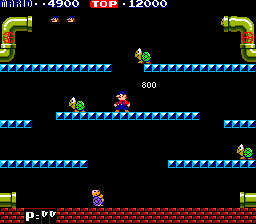
Mario Bros. moves Mario away from Donkey Kong's construction site and into a single-screen arena resembling a New York sewer. Released in 1983, it established Mario and Luigi as plumbers clearing creatures emerging from pipes. The change strengthened their character identity while placing the tension between cooperation and competition at the center.
Hit from Below, Then Collect
Jumping directly on enemies is not the answer. The player strikes the platform from below to flip a creature, then climbs onto the surface to kick it away. This two-step action forces attention to both sides of the platform. The POW block controls crowds, while slippery momentum ensures that plans can quickly turn into accidents.
Two-Player Social Design
Two players sharing one screen can help each other, steal the final kick for points, or accidentally place a partner in danger. The rules do not define teams; the social relationship emerges entirely from player behavior. That ambiguity—producing laughter, rivalry, and temporary alliances in the arcade—is the game's central strength.
The Series' Less Visible Foundation
Mario Bros. lacks the horizontal journey structure of later Super Mario games, yet pipes, turtle-like enemies, Luigi's partner role, and Mario's physical feel become recognizable here. I approach it less as brand history and more as a system that generates behavior between players sharing the same space.
Sources and scope
- Nintendo — Iwata Asks archive
A source link retained from the previous edition. A general company page does not verify a specific historical claim.
- The Strong Museum — Super Mario Bros.
A source link retained from the previous edition. A general company page does not verify a specific historical claim.
- Arcade Database — mario
Metadata provenance link; cached fields were not freshly recrawled from that site in this revision.
Read alongside
This is neither a distribution license nor a play-test report. Public game access requires separate verification of the applicable rights.