

SOURCE-LED ANALYSES
1942: buying space with a limited escape
Reading routes and limited rolls in 1942 through the original manual and two annotated decision diagrams.
Updated ·
Game profile
- Catalog year
- 1984
- Manufacturer
- Capcom
- Genre
- Shooter / Flying Vertical
- Metadata players
- 2
- Set ID
- 1942
An opening is more useful than an empty screen
A vertical shooter invites us to look at enemies first. I prefer to begin with the next opening. Clearing one target matters when it leaves somewhere to move; clearing another may add points without improving the route. This distinction turns shooting into a way of shaping future movement rather than an isolated test of accuracy.
The loop postpones a decision
The original arcade manual describes a limited supply of loops for avoiding enemy attack. I see the manoeuvre as borrowed time. It does not make the next position irrelevant: the aircraft still returns to a field of threats. The useful question is where the player can go afterwards, not simply whether the current danger disappears.
Saving an escape also carries a cost
Keeping a scarce action for later can feel prudent. Yet an unused escape has no practical value if the present route closes. I would compare two readings of the same situation: spending the loop to recover room, or preserving it and accepting a narrower passage. Neither choice is automatically correct; the trade-off is between present space and future options.
Separate the image from the controls
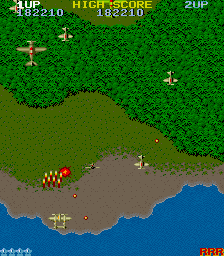
A screenshot can show the aircraft and the available lanes, but it cannot tell us the exact timing of a loop. Likewise, a cabinet button in the manual is not necessarily the key used by a browser. I keep the spatial interpretation separate from control mappings and measurements so the image remains evidence of composition, not a performance report.
Two routes, one starting point
I start the aircraft at the same position in the first diagram. The dashed route heads toward the nearest target but crosses a threat area; the solid route uses the opening on the right. Chasing more targets and preserving room to move produce different choices here. This is not a solution to an actual stage. It is a way of separating a target that opens a route from one that merely attracts attention. Even as a scene speeds up, we can ask where the next exit is.
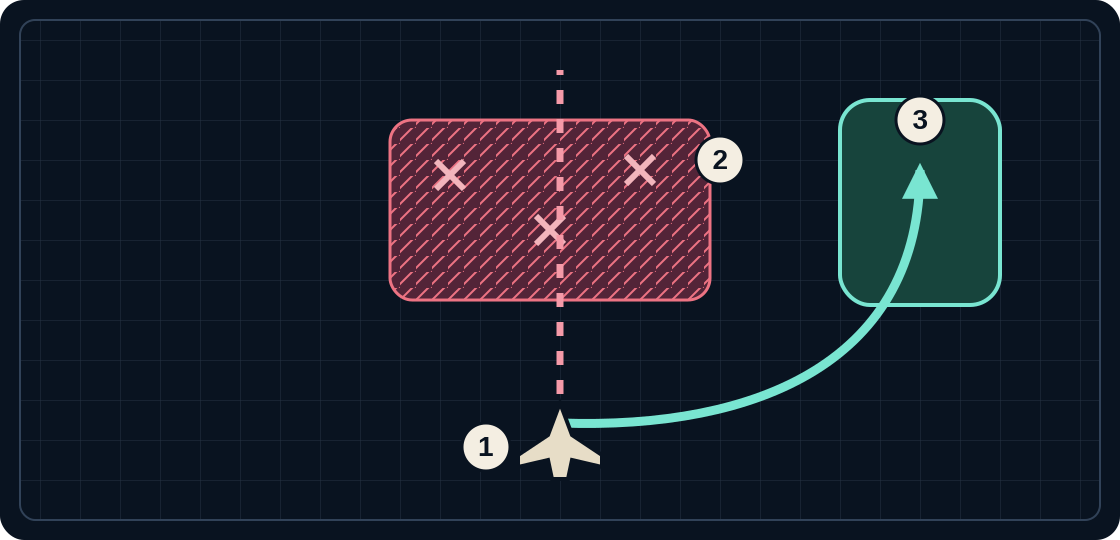
- 1Aircraft starting position
- 2Threat area crossed by the dashed route
- 3Opening reached by the solid route
An unused resource can also earn a reward
Three rolls per wave; unused rolls affect the bonus.
The rule above is on printed page 6 of the manual. The second diagram is my own comparison: keeping the resource means negotiating the narrow opening; spending it means considering a clearer return area. My reading is that possessing a resource does not make saving it the best decision in every situation. A possible bonus has to be weighed against a route that can continue. These positions were not captured in a play session. The diagram does not claim measured roll duration, invulnerability frames or a tested score return.
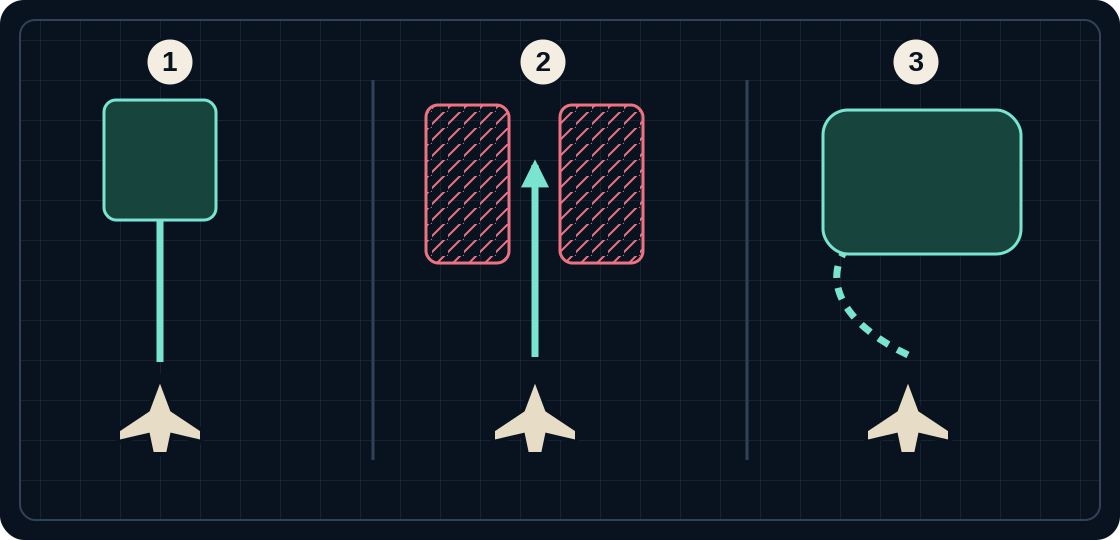
- 1Starting situation
- 2Narrow gap; keeping the resource
- 3Clearer return area; spending the resource
Three questions I ask while looking
- Where would the aircraft return after the escape?
- Which target opens a useful route?
- Is the saved loop protecting a future option or blocking a present decision?
Sources and scope
The linked Capcom arcade manual supports the discussion of the loop. The set record identifies the archived version; the spatial reading is my interpretation, without measured timing or a claimed play session.
Verified claims and sources
- Capcom / Romstar · 1942 manual
- Claim
- Roll limit and the bonus associated with unused rolls.
- Evidence
- Printed p. 6; PDF p. 8 · Game Operation
Numbered drawings are Cinarverse explanatory diagrams, not game screenshots or recorded play tests.