

SOURCE-LED ANALYSES
Galaxian: the time hidden inside one shot
Galaxian's single active shot makes accuracy a question of availability. I read a missed beam as time during which another possibility must wait.
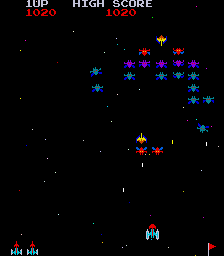
Game profile
- Catalog year
- 1979
- Manufacturer
- Namco
- Genre
- Shooter / Gallery
- Metadata players
- 2
- Set ID
- galaxian
A shot occupies an opportunity
BANDAI NAMCO's game-system page states that another beam cannot be fired until the previous one disappears. I see a missed shot as more than lost accuracy. It occupies the next opportunity to attack. The waiting interval links aim to timing, making an apparently small rule shape the rhythm of the whole encounter.
A formation and a dive ask different questions
A target in formation and one moving towards the player do not create the same reading of danger. I would separate the question of where a target is from where it may meet the aircraft. This shifts attention from lining up a static column to anticipating an encounter. The changing movement is part of the decision, not simply visual variety.
A reward can change the reason to wait
The official description awards more points for attacking enemies in flight. I read that reward as an invitation to accept a more demanding situation. Waiting can make a target more valuable while also changing its threat. The score system therefore gives the player a reason to reconsider the easiest shot, without making the risk disappear.
The pause is useful feedback
A shot that misses leaves a moment in which the player can recognise the consequence of the choice. I value that visible relationship between an action and its next limit. It is easier to understand a rule when the unavailable opportunity can be seen. This reading does not assign exact frame counts: the point is how one committed action changes what can happen next.
Three questions I ask while looking
- Which opportunity is being occupied by the current beam?
- Is the target being read as a position or an approaching movement?
- What extra risk accompanies the more valuable shot?
Shot-timing laboratory
For a moving target, where you aim now may differ from where the target will be when the shot arrives. Change speed and flight time, then compare two decisions.
According to the official description, Galaxian does not allow another beam until the previous one leaves the screen. This example explores how waiting for a new shot relates to leading a moving target.
This interactive diagram does not reproduce Galaxian’s original physics, hitboxes, or frame data. It uses illustrative speed, time, and a ±6-unit tolerance; no game ROM or BIOS is required.
Sources and scope
BANDAI NAMCO's official history and game-system page supports the single-beam rule and airborne scoring distinction. Anticipation and feedback are my design interpretation, without reconstructed frame data.