

SOURCE-LED ANALYSIS
Space Invaders: why a bunker is not simply a safe place
Eroding bunkers and a faster formation in Space Invaders: two rules from TAITO’s original manual and two illustrated design examples.
Updated ·
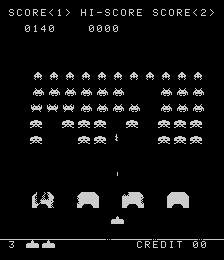
Catalog data — identifies the version
- Catalog year
- 1978
- Manufacturer
- Taito / Midway
- Genre
- Shooter / Gallery
- Metadata players
- 2
- Set ID
- invaders
- Cached status
- GOOD
These fields come from the existing metadata cache dated 30 July 2026. Player count does not promise simultaneous online play, and emulation status is not a test result from this device.
Compare in the catalog →How the primary record is used
TAITO’s own online exhibition describes a 1978 release with a cannon moving along the bottom, a five-row enemy formation and protective bunkers. The Strong supports Nishikado’s design credit. Their evidentiary roles are kept separate rather than treated as one complete production document. Neither historical source establishes present browser performance or permission to distribute a ROM.
Three horizontal regions of the screen
Enemy space, defensive space and the player’s movement line have distinct jobs. Threat appears above, a bunker sits between, and the player changes position below. I read this separation as a spatial vocabulary for a newcomer. Danger, protection and action are not all piled into the same location. Visual simplicity here is a separation of functions, not just a low pixel count.
Taking shelter versus establishing a firing line
Using a bunker is not simply a trip to the nearest safe point. A useful firing position and a position away from danger need not coincide. A defensive object can therefore create negotiation over position rather than passive waiting. This is not a guaranteed shot strategy. The broader design lesson is that the relationship between safe space and action space can itself generate decisions.
Few options do not mean few decisions
One movement axis and a firing action make controls easy to explain, but do not determine when or where to move. This distinction matters when comparing multi-button games. Button count measures input options, not screen states or attentional load. Accordingly, Cinarverse’s catalog comparison displays genre and player metadata but does not fabricate a difficulty score. An unmeasured experience should not be inferred from a data field.
Protection changes with the opening
TAITO’s manual says both enemy attacks and the player’s laser erode fortresses; Invaders move faster as their number decreases.
The first diagram shows an intact bunker and an example with an opening. A shot from above and a laser from below affect the same defensive object. Being under a bunker is therefore not the complete question: what remains directly overhead, and where does the firing line pass? I read the bunker as a tool whose condition needs to be checked again, rather than a fixed safe area. The illustrated opening is not the result of a specified number of shots. No pixel damage or collision area has been measured here.
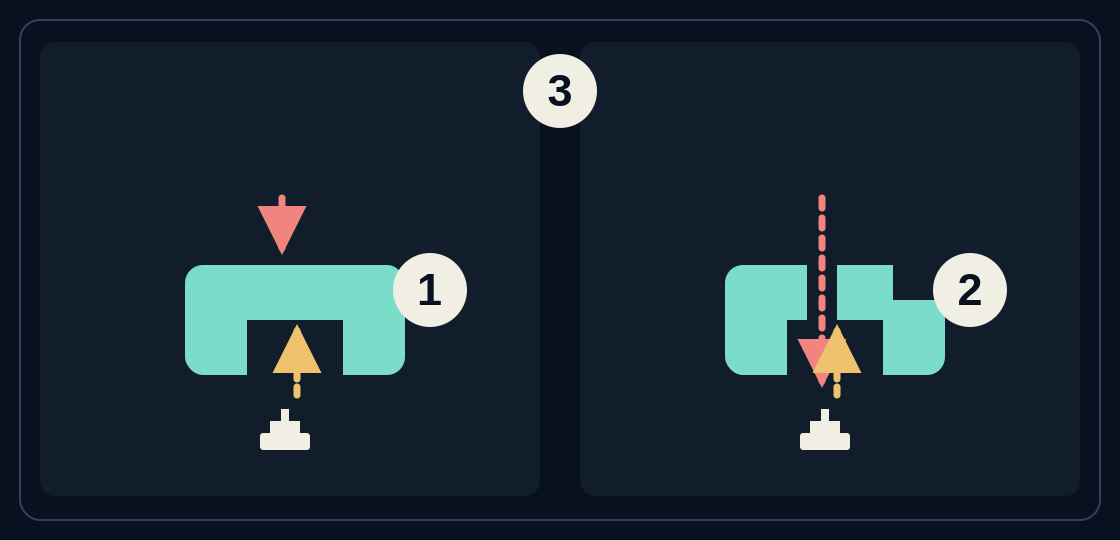
- 1Intact top surface
- 2Illustrative damaged opening
- 3Arrows represent the two firing directions
Fewer targets, a changing tempo
The second diagram contrasts the initial five rows of eleven with an illustrative reduced formation. The manual verifies the increase in speed; the arrows show the relationship without assigning a numerical ratio. Rather than conclude that fewer targets make everything easier, I ask how often I need to adjust my firing position for the remaining target. Clearing the screen also changes its tempo. This is not a guaranteed last-Invader technique. It explains why the number of targets and the time available for decisions are different things.
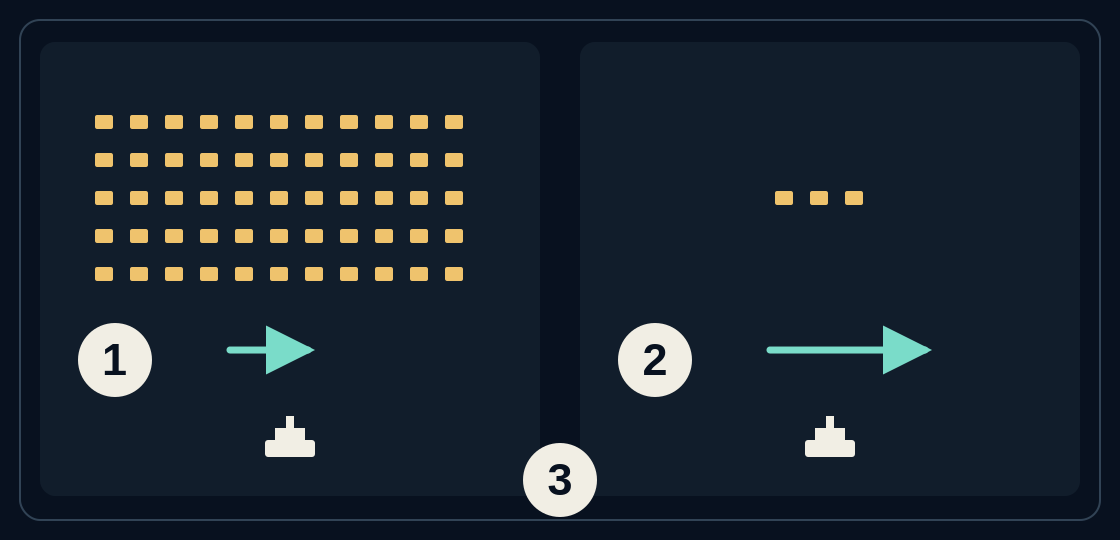
- 1Larger formation
- 2Illustrative reduced formation
- 3Player’s lower movement line remains
What should be examined in an adaptation?
First check whether the full movement line is visible, then whether touch buttons cover defensive space. Simultaneous access to firing and direction is another question. This checklist is not a device test. Phone latency, frame rate and behavioural differences between sets were not measured here; such results should identify the device, emulator core and set when actually collected.
Decision map
| Element | Function | Interpretation |
|---|---|---|
| Enemy space | Threat | Where to look? |
| Bunker space | Defense | Shelter/firing balance |
| Bottom movement line | Action | Position choice |
Limits of the credit information
The Strong identifies designer Tomohiro Nishikado; TAITO’s own exhibition supports release and layout information.
Sources and scope
- TAITO — SPACE INVADERS, the Game Changer
1978 release, five-row formation, bunkers and cabinet formats.
- The Strong — Space Invaders
Nishikado’s design credit and historical context.
- Arcade Database — invaders
Metadata provenance link; cached fields were not freshly recrawled from that site in this revision.
Verified claims and sources
- TAITO · About Space Invaders
- Claim
- Original release and arcade context; embedded videos show the later NESiCAxLive version.
- Evidence
- Official introduction; 1978 and cabinet sections
- TAITO · The Evolution of Space Invaders
- Claim
- Five rows of eleven; cannon, bunkers and Nishikado’s development role.
- Evidence
- TAITO-authored exhibit · 1978 / Space Invaders
- TAITO · Space Invaders manual (SV070019)
- Claim
- Bunker erosion from both directions, faster movement with fewer Invaders and alternating two-player turns.
- Evidence
- Archived original · printed p. 6 / PDF p. 7 · Playing Instructions
Numbered drawings are Cinarverse explanatory diagrams, not game screenshots or recorded play tests.
Read alongside
This is neither a distribution license nor a play-test report. Public game access requires separate verification of the applicable rights.