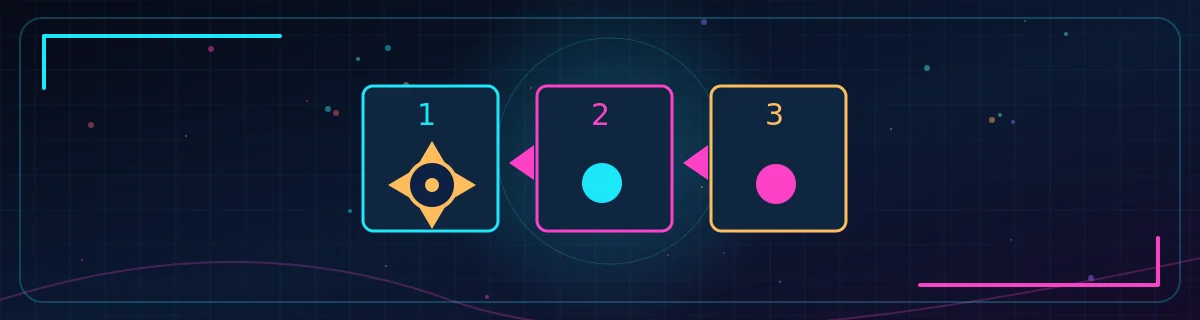
Original illustrative cover created for this article, not a screenshot of an actual game.
Start with a relationship
An arrow beside a character and a visible destination can explain movement more directly than a detached control list. I look for a connection between input, object and outcome. This does not make written instructions unnecessary; it gives them a place in a scene the reader can already understand.
A demonstration has a point of view
An attract sequence can show excitement without showing which decisions produce it. I ask whether the viewer can distinguish player action from automatic motion. Highlighting one control or pausing on one cause-and-effect relationship makes a different kind of introduction from simply replaying a busy section.
Keep help available after the opening
The first encounter is not the only time someone needs an explanation. A returning player may remember the goal and forget a secondary control. I favor a short, reachable guide that uses the same labels as the active controls. Consistency lets the explanation be recognized instead of learned again from a new vocabulary.
Three questions I ask while looking
Which first action is being taught?
Can I connect input with its result?
Can I find the explanation again later?
First show a cue, then feedback, then a longer explanation
Imagine an arcade opening with two buttons and movement. Instead of ten lines of instructions, the first move gets a directional cue; movement triggers brief confirmation; a special move is explained when it becomes relevant. The sequence spreads learning across real choices.
When reviewing the opening, separately record upfront information, the player’s first meaningful goal, and the hint shown after a failed attempt. This is a proposed teaching pattern, not the result of a completed player study.
This is a design interpretation, not a device measurement or evidence of developer intent.
Further reading and source scope
These references concern general interface principles; they do not verify the games’ developer intent.