

SHORT DESIGN NOTE
Shinobi
A short design note from the previous edition; not a new play-test report.
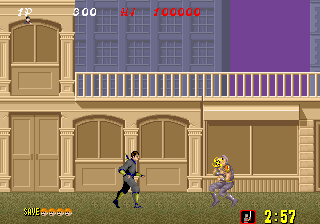
The historical team credits and all external sources of this short note were not reverified in this revision. Do not read interpretation as a measured play test.
Catalog data — identifies the version
- Catalog year
- 1987
- Manufacturer
- Sega
- Genre
- Platform / Fighter Scrolling
- Metadata players
- 2
- Set ID
- shinobi
- Cached status
- GOOD
These fields come from the existing metadata cache dated 30 July 2026. Player count does not promise simultaneous online play, and emulation status is not a test result from this device.
Compare in the catalog →Dividing Ninja Fantasy into Compact Missions
SEGA's 1987 Shinobi sends Joe Musashi to rescue kidnapped students from a criminal organization. Each mission rebuilds the objective of finding hostages and reaching the exit inside a different city or base arrangement. Ninja fantasy is interpreted less through stealth than through precise attack, sudden layer changes, and controlled progress.
Separating Close and Ranged Attacks
Musashi throws shuriken at range and switches to sword or strikes when close. One attack button changes with context, keeping controls simple while making distance meaningful. Upward and downward leaps move between foreground and background platform layers, turning a flat corridor into a tactical space.
Ninjutsu: One Major Decision per Stage
Ninjutsu can clear a crowded screen or deal important boss damage, but its use is limited. Players choose between rescuing a bad moment and saving it for a larger threat. First-person shuriken bonus stages reinterpret the theme as a brief accuracy test from another perspective.
The Value of Deliberate Action
Shinobi looks fast, yet constant forward movement is often punished. Enemy placement, layer changes, and hostage positions reward brief pauses for reading. I see it as a deliberate action design where power fantasy emerges from correct range, a one-use resource, and stage knowledge rather than unrestricted motion.
Sources and scope
- SEGA — Games
A source link retained from the previous edition. A general company page does not verify a specific historical claim.
- Arcade Database — Shinobi
A source link retained from the previous edition. A general company page does not verify a specific historical claim.
- Arcade Database — shinobi
Metadata provenance link; cached fields were not freshly recrawled from that site in this revision.
Read alongside
This is neither a distribution license nor a play-test report. Public game access requires separate verification of the applicable rights.