

SOURCE-LED ANALYSIS
Street Fighter II Champion Edition: a decision language from six buttons
Separating the 1992 arcade set from the broader series while examining strength, distance and decisions after an attack.
Catalog data — identifies the version
- Catalog year
- 1992
- Manufacturer
- Capcom
- Genre
- Fighter / Versus
- Metadata players
- 2
- Set ID
- sf2ce
- Cached status
- GOOD
These fields come from the existing metadata cache dated 30 July 2026. Player count does not promise simultaneous online play, and emulation status is not a test result from this device.
Compare in the catalog →Keeping series and set distinct
Cinarverse’s sf2ce record denotes the 1992 Champion Edition arcade set. A general museum essay is useful for the series’ influence but does not verify every detail of this set. The Special Champion Edition home manual concerns another version too. These sources are presented with those limits. I make no claims about move frame counts, damage tables or definitive balance rankings across versions.
Why strength is not just a damage choice
Presenting light, medium and strong actions within the same family gives the player an ordered vocabulary. Treating the strongest-looking button as universally correct, however, removes distance and time from the decision. I interpret the six-button layout as a reusable decision structure rather than just a power hierarchy. “What risk does this choice take here?” matters alongside “which one hits hardest?”
Distance as a resource without a meter
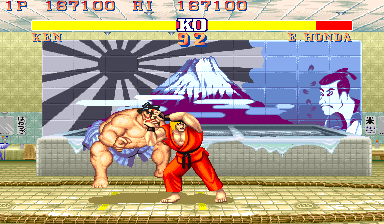
A health display makes a resource visible; distance has no separate meter. Yet the gap between characters changes which actions make sense. The fighting screen is therefore more than an animation showcase: empty space carries information too. The interface lesson is that not every resource needs a counter. Relationships between objects can be the decision’s most important indicator.
Reading the control layout
The strength labels below describe a control family conceptually. They do not guarantee identical speed or reach relationships for every move of every character. A browser’s A, B and C labels must also be checked against the intended functions. Drawing six buttons is not proof that they are mapped correctly. Every character’s inputs were not manually tested for this edition.
A first learning goal: read the result
When learning a licensed version, observing one action at different distances can be a useful exercise instead of attempting a new special move every time. The aim is not a tournament prescription, but making the input/result relationship visible. Failure may involve the wrong button, distance or moment. Distinguishing those possibilities turns a memorized command list into a system that can be investigated.
Decision map
| Element | Function | Interpretation |
|---|---|---|
| Punch family | Light · Medium · Strong | Strength choice |
| Kick family | Light · Medium · Strong | Separate action family |
| Direction | Position and defense | Reading distance decisions |
Limits of the credit information
The catalog records Capcom and 1992. This dossier does not claim to provide verified individual credits or measured frame data.
Sources and scope
- The Strong — Street Fighter II
Series history and cultural context, not Champion Edition-specific balance or frame data.
- SEGA / Capcom — Special Champion Edition kılavuzu
Punch/kick strength labels in a home adaptation; not evidence for arcade input timing.
- Arcade Database — sf2ce
Metadata provenance link; cached fields were not freshly recrawled from that site in this revision.
Read alongside
This is neither a distribution license nor a play-test report. Public game access requires separate verification of the applicable rights.