

SOURCE-LED ANALYSES
Knights of the Round: reading growth during a fight
I read Knights of the Round at two scales: the immediate distance to an opponent and the longer promise of a character becoming stronger.
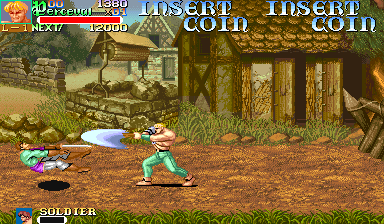
Game profile
- Catalog year
- 1991
- Manufacturer
- Capcom
- Genre
- Fighter / 2.5D
- Metadata players
- 3
- Set ID
- knights
Two clocks on one screen
A close-range fight asks for an immediate response, while character progression points towards a later reward. I find the tension between these clocks more interesting than a simple accumulation of strength. A desirable reward can encourage a risky approach now; the promise of future improvement does not remove the need to read the current encounter.
Growth should be visible
Weapons and armour give progression a visible form. I read that change as feedback about the journey rather than mere costume variation. A number can state that progress occurred, but a recognisable silhouette lets it remain present during movement. The interface is stronger when the player can notice development without repeatedly leaving the action to inspect a counter.
Distance comes before a long combination
A shared horizontal scene can make two figures look close even when their vertical positions differ. I would check alignment before thinking about a sequence of attacks. That small visual distinction helps explain why apparent proximity and a useful attacking position are different things. The issue is spatial judgement, not a universal button recipe.
A party shares more than the picture
Several characters on screen create a shared field of attention. Another fighter can occupy the space where I expected to move, and an attractive reward can pull attention away from an approaching opponent. I read cooperation as a negotiation over room and priorities. More characters bring more possibilities, but the composition must keep those possibilities distinguishable.
Three questions I ask while looking
- Can character growth be noticed without reading a number?
- Are the opponent and the knight actually aligned?
- Which shared space needs to remain clear for the party?
Sources and scope
The original Capcom arcade documentation and linked set record anchor the game and version. Progression and spatial composition are discussed without exact experience tables, complete staff credits or a claimed multiplayer test.