

SHORT DESIGN NOTE
Joust
A short design note from the previous edition; not a new play-test report.
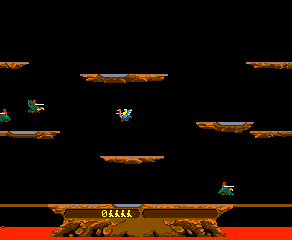
The historical team credits and all external sources of this short note were not reverified in this revision. Do not read interpretation as a measured play test.
Catalog data — identifies the version
- Catalog year
- 1982
- Manufacturer
- Williams
- Genre
- Platform / Run Jump
- Metadata players
- 2
- Set ID
- joust
- Cached status
- GOOD
These fields come from the existing metadata cache dated 30 July 2026. Player count does not promise simultaneous online play, and emulation status is not a test result from this device.
Compare in the catalog →Lances, Knights, and Flying Ostriches
Designed by John Newcomer and released by Williams in 1982, Joust transforms a knightly duel into an absurd aerial sport. Players collide above platforms while riding ostrich-like mounts. The fantasy theme is recognizable, but the game's identity comes from the strange, delayed physics of flapping rather than realistic flight.
Altitude as an Attack Value
The lance positioned higher at impact wins, while an even collision repels both riders. That single rule converts the entire arena into a vertical tactical map. The player does not simply approach an opponent but flaps rhythmically to establish a superior angle. Collecting a fallen enemy's egg in time prevents a new threat from hatching.
Cooperation That Easily Becomes Rivalry
Two players naturally cooperate to clear a wave, yet the same collision rule lets them eliminate one another. The game does not separate cooperative goals and personal score through menus. The relationship can therefore change from second to second, making social decisions at the cabinet as important as scripted rules.
Producing Behavior with Few Rules
Joust shows how a small move set can create many outcomes when combined with physics, position, and player intent. The lava troll, pterodactyl, and changing platforms vary the pressure without replacing the central rule. I see it as an early design laboratory where mechanical economy and social surprise work together.
Sources and scope
- The Strong Museum — Joust
A source link retained from the previous edition. A general company page does not verify a specific historical claim.
- Arcade Database — Joust
A source link retained from the previous edition. A general company page does not verify a specific historical claim.
- Arcade Database — joust
Metadata provenance link; cached fields were not freshly recrawled from that site in this revision.
Read alongside
This is neither a distribution license nor a play-test report. Public game access requires separate verification of the applicable rights.