

SOURCE-LED ANALYSES
Commando: cover, movement and the cost of a grenade
Commando gives me two different questions: how to keep a route open, and when a limited attack is worth more than another burst of gunfire.
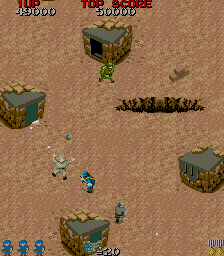
Game profile
- Catalog year
- 1985
- Manufacturer
- Capcom
- Genre
- Shooter / Walking
- Metadata players
- 2
- Set ID
- commando
Moving forward is not the whole plan
An upward-scrolling scene suggests a clear destination, yet progress depends on the space around the soldier. I read an open strip as a temporary opportunity rather than a permanent safe lane. A route that works now can become restrictive once another threat enters it. Forward movement therefore needs an accompanying plan for a sideways exit.
Two weapons, two kinds of commitment
The original manual distinguishes unlimited machine-gun shots from a limited grenade supply. That difference makes the second weapon interesting even before its damage is considered. Gunfire can be repeated; a grenade asks the player to decide that this particular situation deserves a resource. I read the choice as an assessment of urgency, not just destructive power.
Cover rearranges the problem
The manual names trees and walls as cover. For me, their value is relational: an obstacle changes what can approach from one side while also limiting movement around it. Treating cover as an unconditional refuge misses that exchange. The better question is which line of danger it interrupts and which escape route remains available.
The route can reveal the mistake
A crowded scene may look like a failure to shoot quickly enough. I would first ask whether the chosen route made several threats arrive together. This reading leaves room for a useful lesson: improve the order in which dangers are encountered before assuming that faster input will solve them. The argument concerns decisions, not a promised high-score technique.
Three questions I ask while looking
- Which way out remains beside the cover?
- What makes this situation worth a grenade?
- Did the route combine threats that could have been faced separately?
Sources and scope
The Capcom / Data East USA arcade manual documents weapons and cover. The set record supplies version metadata; the route analysis is an editorial interpretation, not a measured combat test.