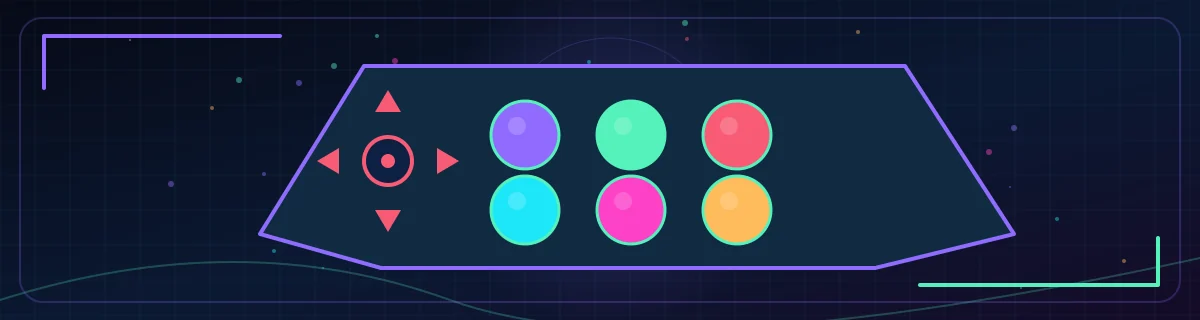
Original illustrative cover created for this article, not a screenshot of an actual game.
Why Three Strength Levels Are Legible
In a six-button layout, punches and kicks are divided into light, medium, and heavy strengths. Players form a broad expectation without memorizing every move: light attacks are fast but short and less damaging; heavy attacks are slower yet stronger or longer-reaching. Medium buttons fill the space between. Six commands are therefore grouped mentally as two attack families and three intensity levels rather than a flat list. Good control design is not only about reducing buttons but also building a meaningful hierarchy among them.
Distance, Time, and Risk
An attack's value is not limited to damage. Startup, active frames, recovery, and occupied space work together. A light punch may interrupt movement at close range; a heavy kick threatens from farther away but becomes punishable when missed. Six buttons distribute these risks across physical locations. The hand feels strength while the eye watches the screen. Two rows on an arcade panel translate classification into muscle memory.
Why Special Moves Need No Separate Button
Special moves such as the Hadoken combine a directional sequence with an existing attack button rather than adding another key. The command space expands without enlarging the panel. Chosen punch or kick strength often changes speed, range, or damage, creating another decision inside one move family. Input error is part of the system: intention must be expressed through direction and timing. A special move therefore represents execution skill as well as knowledge.
Preserving Physical Logic on Mobile
On touchscreens, shrinking six buttons into one line may appear functional, yet finger overlap and accidental input quickly undermine fighting play. Cinarverse exposes the required number of buttons by game profile; when six are needed it uses two rows and deliberate spacing. Touch area, hold behavior, and prevention of browser zoom matter as much as labels. The goal is not to draw a picture of a physical cabinet but to translate its decision hierarchy onto another surface.